Source: Moneycontrol.com
The contraction seen in discretionary demand poses a major worry for Aarti Industries
Highlights
- Q1 results affected by Covid-related disruptions and soft demand
- Near term outlook uncertain due to high share of cyclical end market
exposure
- Medium term earnings outlook of 15-20% growth
- Long term prospects due to
China opportunity remains intact
Aarti Industries’s (CMP: Rs 1,000, Mkt Cap: Rs
17,389 crore) performance paused due to heightened uncertainty around demand
for aromatic chemicals. While the specialty chemicals’ company can benefit from
the opportunity to substitute China as a source for the pharmaceutical and
chemical products, it warrants a relook due to the recent termination of a long
term contract, high exposure to cyclical sectors and elevated valuation.
Table: Q1 financials - consolidated

Key highlights of Q1 results
Aarti’s Q1 revenue declined by about 10 percent YoY
due to soft end-market trends and Covid-19 related restrictions. The specialty
chemicals segment which constitutes 81 percent of sales de-grew by 11 percent,
largely due to the lockdown’s impact and lower capacity utilization. The pharma
segment, which accounts for the rest of sales, grew by 2 percent only.
Overall, EBITDA (Earnings before interest, tax,
depreciation and amortization) margins were severely affected by higher
operational costs for new facilities and operational deleverage. This partially
explains the drop in segmental operating profit margin for the specialty
chemicals segment to 15.5 percent (-711 bps). However, the pharma segment
continued to exhibit improvement in this metric to 23.2 percent (+644 bps) due
to increased share of value-added products.
Other observations:
Among key capex projects, the chlorination plant
project at Jhagadia is expected to be live in the current quarter. Other
investment projects include that for pharma, NCB (Nitro Chloro Benzene) and for
executing multi-year contracts,
A long term contract worth Rs 10,000 crore for a
20-year supply of chemical intermediates is expected to be commissioned in H2
FY21. Investments towards the NCB value chain would be completed in two phases.
The first one is to be completed in the current fiscal and the second one by H2
FY22. The NCB capacity is targeted to increase to 108,000 tonnes from 75,000
tonnes with an investment of Rs 150 crore.
Additionally, with the enhancement of R&D
capabilities, the company expects to enter new lines of chemistry and products.
The focus will be on supply chains for value-added products requiring multiple
levels of synthesis and completely independent of intermediate supplies from
China.
In case of the pharma segment, the company is
looking for API (Active Pharmaceutical Ingredient) and intermediates’ capacity
expansions catering to therapies such as antihypertensive, cardiovascular,
oncology and corticosteriods. It is also looking to capture increased
domestic sourcing of pharma intermediates by clients due to the China factor.
The government’s incentive scheme for APIs is also going to help in higher
demand for intermediates from domestic manufacturers.
Outlook
The management has updated that a large part of the
operational hurdles in terms of logistics and labour availability have been
sorted and capacity utilization is now nearing 90 percent. Looking beyond the
termination of a multi-year contract, it is comforting that the progress in
other projects remains directionally on track and is backed by a capex budget
of Rs 1,000 -1,200 crore in the current year.
Having said that, the contraction seen in
discretionary demand is a major worry for a diversified chemical producer such
as Aarti industries. In the quarter gone by, sales were skewed towards pharma
and agrochem end-markets, which in the normal course contributes about 40
percent of sales. Demand for some relevant applied sectors for chemicals such
as auto, textiles, polymers, construction electronics, oil & gas and
aerospace remain uncertain for the current year.
However, the management believes that Q1 FY21 was
the worst quarter in terms of business impact and expects to see sequential
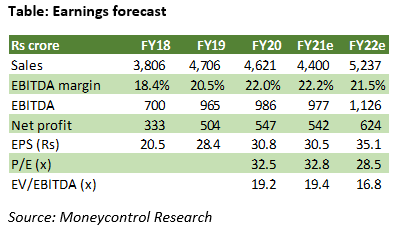
volume growth in Q2. It is projecting positive EBITDA growth and flattish net
profit growth in FY21 due to rising depreciation and interest expenses. Over
the medium term (3-4 year time horizon), the management is projecting 15-20
percent earnings CAGR using FY20 as a base.
While we remain skeptical about the shorter term
prospects, the longer term guidance seems plausible as current crises adds to the
growing theme of India as an alternative base for sourcing chemicals.
Additionally, large chemical players such as Aarti industries are better
positioned to deal with near term hurdles with respect to operations, supply
chain and working capital management, helping it gain market share in the
domestic market.
In the long term, the company is well placed to
capture this opportunity due to its increasingly vertically integrated model.
It is working on 15-20 downstream products aimed at capturing the domestic
demand opportunity through import substitution. It is also exploring newer
chemistry value chains such as the chlorotoluene chain.
Among factors that require close attention are
leverage (Net debt/Equity: 0.52x) and the promoter’s stake. Promoter’s shareholding
has been reducing over the years. In the June’20 filing it was 47.45 percent
compared to 51.07 percent in March’18 filing.
As far as the stock is concerned, it currently
trades at an expensive valuation of 16.8x FY22 EV (Enterprise
Value)/Ebitda. Although the company presents a promising structural
opportunity, weak near term earnings visibility warrants waiting for better
levels to accumulate.
Comments
Post a Comment