
KKR-Reliance Retail deal: Value unlocking story continues

Deal with KKR marks the second monetisation in Reliance Retail

Highlights
KKR to invest Rs 5,550 crore for a 1.28 percent stake in Reliance Retail
- Deal values Reliance Retail at Rs 4.33 lakh crore
- Synergy benefit with Future Retail will drive future upside

- RIL shareholders should see further upside with two engines of growth firing

Reliance Industries  continued to walk the path it had clearly mentioned in its annual general meeting earlier this year. Then, it had announced that it was looking for strategic as well as financial investors for its retail venture. After the acquisition of Future group’s wholesale and retail businesses for Rs 25,000 crore in the last week of August, Reliance Industries has now started monetising its stake in Reliance Retail. After Silver Lake committed to buy a 1.75 percent stake for Rs 7,500 crore, KKR has now decided to invest Rs 5,550 crore in the retail unit. Its price for a 1.28 percent stake in Reliance Retail Ventures values the entity at Rs 4.33 lakh crore. KKR had already committed a Rs 11,367-crore investment in Jio Platforms.

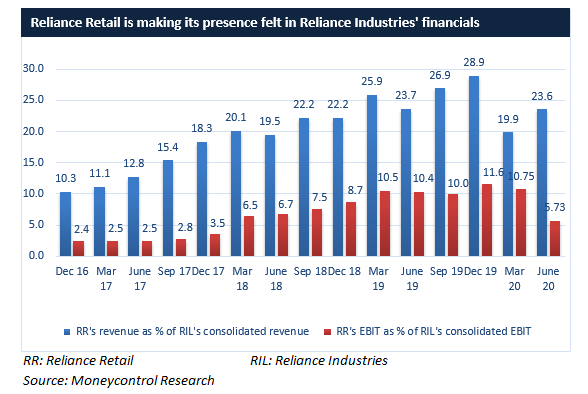
As per various reports, India’s retail market is likely to be around $1.5 to $2.0 trillion by 2030 of which organized retail is likely to be around $400 billion and the e-commerce market is likely to be around $300 billion. Presence in both the online and offline channels will help Reliance Retail in tapping both the opportunities. With the acquisition of the Future group’s retail assets, segments such as lifestyle and grocery will become big contributors. Already Reliance Retail has become a big vertical of RIL over time. The pandemic-induced lockdown had adversely impacted growth in the retail sector. However, with the gradual opening up of the economy, we expect Reliance Retail to return to the growth path.


Creating room for future growth while keeping the balance sheet light

A key strategic move by RIL has been to improve the quality of its balance sheet. Helped by 14 bulge-bracket deals and a Rs 53,000-crore rights issue, the company achieved its zero net debt target much before the deadline. Overall, capital raised has been to the tune of Rs 2.13 lakh crore well above the reported consolidated debt numbers. Of this, about Rs 23,000 crore would be retained at the Jio Platform level.

Table: RIL’s net cash post investments

Source: Moneycontrol Research, RIL

With the requisite growth capital available to Jio, the time is now ripe for RIL to fire up another growth engine — the retail segment.  The stake sale in Reliance Retail will provide growth capital and help it reduce debt. As on March 31, 2020, Reliance Retail had a debt of Rs 4,618 crore.

Coming to valuations, Reliance Industries’ current market cap is around Rs 15 lakh core.

The KKR investment is slightly above Silver Lake’s valuation. However, since it is a very small private equity investment, it shouldn’t be seen as the only benchmark for the valuation of Reliance Retail. The way Reliance is using JioMart along with the Whatsapp platform and its large offline presence, achieved through the acquisition of Future’s business, we expect the retail business to be significantly re-rated in the future.


Read Full article


Comments

Popular posts from this blog

Panacea Biotech shares hit 5% upper circuit after dengue vaccine completes phase I & II study

DengiAIl induced robust neutralising antibody responses against all the four dengue virus serotypes, the company has said in an exchange filing. Panacea Biotech share price hit 5 percent upper circuit on the BSE on September 24 after the company completed phases I and II study of its dengue vaccine candidate DengiAIl. "Panacea Biotec Ltd. is delighted to announce the successful completion of its Phase I/II study to evaluate the safety and immunogenicity of its vaccine, DengiAll, a single-dose liveattenuated tetravalent vaccine," the company said in an exchange filing. Live-attenuated vaccines contain weakened bacteria or viruses that trigger an immune response but do not cause disease. The company said DengiAIl induced robust neutralising antibody responses against all the four dengue virus serotypes. DengiAIl has been found to be safe and well-tolerated with no serious adverse effects, the company said. After a single-dose, more than 80 percent of the participants ...

Taking Stock | Profit-booking pulls Nifty below 14,450; Sensex drops 549 points

  All the sectoral indices ended in the red with IT and PSU bank indices falling 2 percent each. The market remained under pressure on January 15 on the back of profit-booking across sectors amid weak global cues. At close, the Sensex was down 549.49 points or 1.11% at 49,034.67, and Nifty was down 161.90 points or 1.11% at 14,433.70. "The market witnessed profit-booking and following global trends. Nifty continues to resist 14,600 and has taken a dip towards 14,360. If the market closes below 14,380 levels, we might see a correction till the levels of 14,180-14,200. Momentum indicators like RSI, MACD are indicating a small correction in the markets," said Ashis Biswas, Head of Research at CapitalVia Global Research. All the sectoral indices ended in the red with IT and PSU bank falling 2 percent each. Broader markets performed in line with the main indices with BSE Midcap and Smallcap indices falling 1 percent each. Tech Mahindra, GAIL, HCL Tech, Wipro and ONGC...

Similar to 2020, D-Street is at record high ahead of Budget 2021; will history repeat itself?

  Experts are of the view that a repeat of 2020 or what happened in March might not be possible but some consolidation cannot be ruled out. Back in March when everyone wanted to write-off 2020 from their books, hope and liquidity supported markets and investor sentiment. Nobody thought that after touching a 3-year low in March 2020, benchmark indices would give double-digit returns by the end of the year. The S&P BSE Sensex and Nifty50 rallied by about 15 percent in 2020 and the big outperformance came from the small and midcap stocks. The rally is still continuing in 2021. The S&P BSE Sensex, which climbed Mount 49K, is up over 3 percent while the Nifty50 is up over 4 percent so far in January. Sensex scaling the 49,000-mark and Nifty50 touching 14,500 levels ahead of the Budget 2021 could make anyone cautious about the strength of the rally. Back in January 2020, both Sensex and Nifty touched fresh highs ahead of Budget, and then the market fell like a pack of cards. The ...